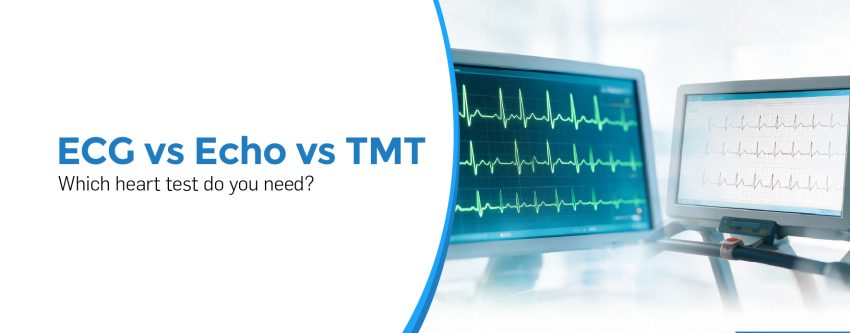
When it comes to heart health, doctors may recommend different tests depending on your symptoms, age, medical history, and risk factors. Three commonly advised investigations are an ECG, echocardiography, and a TMT. Although all three are related to the heart, they provide different types of information.
Understanding the difference between these tests can help you know why your doctor has recommended a particular investigation and what it can reveal about your heart.
What Is ECG, Echo and TMT Tests?
ECG: Checking the Heart’s Electrical Activity
An ECG Test records the electrical activity of the heart. Small electrodes are placed on the chest and sometimes on the arms and legs. The test records the heart’s rhythm, rate, and electrical signals.
An ECG may help identify:
- Irregular heart rhythms
- Abnormal heart rates
- Certain changes associated with reduced blood flow to the heart
- Previous or ongoing heart-related abnormalities
- Some conduction problems
The test is quick, painless, and usually takes only a few minutes.
Echo: Looking at the Heart’s Structure and Function
An echo test uses ultrasound waves to create moving images of the heart. Unlike an ECG, which focuses on electrical activity, an echo allows doctors to examine the heart’s structure and how effectively it is working.
An echocardiography test can provide information about:
- Heart chamber size
- Heart muscle movement
- Heart valve function
- Blood flow through the heart
- Pumping function of the heart
- Fluid around the heart
It is commonly recommended when a doctor needs a closer look at the heart’s anatomy and performance.
TMT: Evaluating the Heart During Exercise
A TMT Test, or treadmill test, assesses how the heart responds to physical activity. During the test, you walk on a treadmill while your heart rate, rhythm, blood pressure, and ECG changes are monitored.
Because the heart must work harder during exercise, a TMT may help doctors identify abnormalities that are not apparent when the person is resting.
It may be recommended for people experiencing symptoms such as chest discomfort during exertion, unexplained breathlessness, or reduced exercise tolerance.
ECG vs Echo vs TMT: What Is the Difference?
Although these tests are often discussed together, they answer different questions.
| Test | What It Evaluates | Common Purpose |
| ECG | Electrical activity | Heart rhythm and electrical abnormalities |
| Echo | Heart structure and function | Valves, chambers, heart muscle and pumping function |
| TMT | Heart response to exercise | Assessing changes that may occur during physical exertion |
The tests are not necessarily alternatives to one another. In some situations, a cardiologist may recommend more than one test to get a complete picture of heart health.
Which Test Do You Need?
There is no single test that is suitable for everyone. Your doctor decides which investigation is appropriate after considering your symptoms, health history, physical examination, and risk factors.
When an ECG May Be Recommended
An ECG may be considered when you have symptoms such as:
- Palpitations
- Chest discomfort
- Dizziness or fainting
- Unexplained weakness
- Irregular heartbeat
- Breathlessness
It may also be part of an evaluation before certain surgeries or during routine cardiac assessment.
When an Echo May Be Recommended
An echo can be useful when the doctor wants to evaluate the heart’s structure or pumping ability. It may be recommended if there are abnormal heart sounds, suspected valve problems, unexplained breathlessness, swelling, or concerns about heart function.
When a TMT May Be Recommended
A treadmill test may be recommended when symptoms appear or worsen during physical activity. It can help assess how the cardiovascular system responds when the heart is working harder.
However, TMT is not appropriate for every patient. Your cardiologist will determine whether it is safe and useful based on your overall condition.
What Are the Signs That You May Need a Heart Evaluation?
Some signs of heart problems can be mild or easily mistaken for other conditions. Persistent or unexplained chest discomfort, breathlessness, palpitations, dizziness, fainting, unusual fatigue, or swelling of the legs may require medical evaluation.
Similarly, heart disease symptoms can vary considerably from person to person. Some individuals may experience symptoms mainly during physical activity, while others may have symptoms even at rest.
If symptoms are sudden, severe, or accompanied by significant chest pressure, difficulty breathing, fainting, or other concerning changes, seek urgent medical attention rather than waiting for a routine appointment.
Can These Tests Detect Heart Failure?
Heart failure occurs when the heart cannot pump or fill with blood effectively enough to meet the body’s needs. There can be several heart failure causes, including coronary artery disease, high blood pressure, heart valve disease, heart muscle disorders, and certain rhythm problems.
An ECG can provide information about the heart’s electrical activity, while an echo can assess heart structure and pumping function. Other investigations may also be required depending on the suspected cause.
What Happens After the Test?
The next step depends on the findings. A normal result may provide reassurance, while an abnormal result may require additional evaluation.
Depending on the diagnosis, heart disease treatment may involve lifestyle changes, medicines, procedures, surgery, or regular monitoring. Treatment is always tailored to the individual’s condition and risk factors.
Why Regular Heart Checkups Matter
Heart problems do not always cause obvious symptoms in their early stages. Regular health assessments can be particularly valuable for people with risk factors such as high blood pressure, diabetes, high cholesterol, obesity, smoking history, family history of cardiovascular disease, or a sedentary lifestyle.
Depending on your age and risk profile, health checkup packages may include cardiovascular assessments along with other routine investigations.
Choosing the Right Cardiac Care
The choice between ECG, echo, and TMT should not be based on the name of the test alone. Each investigation serves a different purpose, and the right test depends on what your doctor is trying to evaluate.
If you are experiencing concerning symptoms or have cardiovascular risk factors, consult a qualified cardiologist who can assess your condition and recommend appropriate investigations. You can find a doctor based on your healthcare needs and discuss whether you require an ECG, echo, TMT, or another cardiac evaluation.
For patients seeking specialist cardiac care, the best cardiologist in Delhi can provide comprehensive evaluation and guide you toward appropriate testing and treatment.
Cardiac Care at Venkateshwar Hospital
Venkateshwar Hospital provides comprehensive cardiac evaluation and treatment supported by experienced specialists, advanced diagnostic facilities, and multidisciplinary care.
For patients looking for a Best Heart Hospital in Delhi, timely consultation and appropriate diagnostic evaluation can play an important role in identifying cardiovascular conditions and planning suitable care.
Conclusion
ECG, echo, and TMT are valuable cardiac investigations, but they serve different purposes. ECG primarily evaluates electrical activity, echo examines the heart’s structure and function, while TMT assesses the heart’s response to exercise.
Your doctor may recommend one test or a combination of investigations depending on your symptoms and medical history. If you have persistent or unexplained symptoms, getting evaluated early can help identify potential heart problems and support timely management.
Frequently Asked Questions
Is an ECG better than an echo?
Neither test is universally better. An ECG evaluates the heart’s electrical activity, whereas an echo examines its structure and function. The appropriate test depends on what your doctor needs to investigate.
Is a TMT necessary if my ECG is normal?
Not necessarily. A normal resting ECG does not automatically determine whether a TMT is required. Your doctor may recommend a treadmill test based on your symptoms, risk factors, and clinical assessment.
Is an echocardiogram painful?
No. A standard echocardiogram is generally painless and non-invasive. A technician moves an ultrasound probe over the chest to obtain images of the heart.
How long does an ECG take?
A standard ECG usually takes only a few minutes, although preparation and electrode placement may add some additional time.
Can an echo detect heart blockage?
An ordinary echocardiogram does not directly show every coronary artery blockage. However, it can provide information about heart function and certain changes associated with cardiovascular disease. Other tests may be required to evaluate the coronary arteries.
Can TMT detect heart disease?
A TMT can help evaluate how the heart responds to exercise and may identify certain abnormalities associated with reduced blood supply during exertion. It is not suitable for diagnosing every type of heart condition.
Which heart test is usually done first?
The first investigation depends on the person’s symptoms and clinical situation. An ECG is commonly used as an initial cardiac assessment, but your doctor may recommend an echo, TMT, blood tests, or other investigations depending on the circumstances.
Should I get these tests as part of a routine health checkup?
Not everyone needs all three tests routinely. The need for cardiac testing depends on your age, risk factors, symptoms, and medical history. Discuss your individual requirements with your healthcare provider.
Written & Verified By:

Dr. Rakesh Chugh MBBS, MS, DNB
Director & HOD Cardio Thoracic & Vascular Surgery
Meet The Doctor